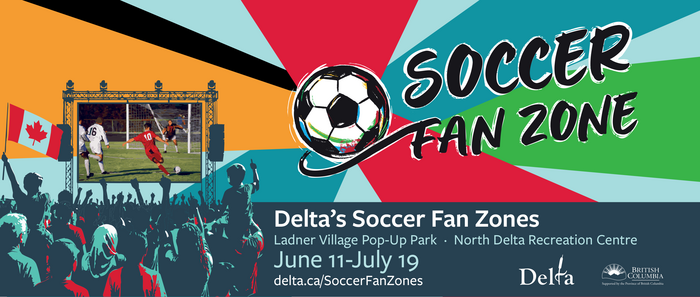
The City of Delta is welcoming the FIFA World Cup 2026 by launching community-wide Soccer Fan Zones, using provincial grants to completely offset municipal costs, and offering free outdoor physical activities designed to grow the sport within the City of Delta.
Thanks to the City of Delta for the following info:
Running from June 11 through July 19, 2026, this 39-day festival establishes vibrant hubs at the Ladner Village Pop-Up Park (Chisholm Street Wharf) and the North Delta Recreation Centre.
Delta has designed a full calendar of outdoor, active programming to promote physical health and soccer engagement alongside the live big-screen match broadcasts:
- Fan Zone Fitness Series: The city hosts free outdoor fitness programs including Pre-Game Power HIIT and family-friendly Zumba classes right before major match times.
- Drop-In Soccer Matches: Organized drop-in soccer sessions are available to the public on Tuesdays and Thursdays to get community members active on the field.
- Soccer-Themed Activations: Interactive street games, family play zones, and soccer skill challenges are integrated along Chisholm Street.
- Family-Friendly Festivals: Special events like video game tournaments, Father’s Day pancake breakfasts, and large-scale street parties celebrate soccer culture.
The City of Delta minimized the impact on local taxpayers through strategic financial planning and senior government funding:
By keeping every watch party, fitness class, and soccer activation completely free of charge, Delta removes financial barriers to entry.
The goal is to build an inclusive atmosphere where youth, casual fans, and diverse cultural groups can collectively engage with the sport, translating the energy of the global tournament into a long-term local soccer legacy.
Promoting the FIFA World Cup 2026 in the Lower Mainland grows minor youth sports through grassroots infrastructure investments, direct community programming, and heightened public visibility.
However, this comes at a total gross taxpayer cost estimated between $685 million and $729 million.
Here is how the promotion directly impacts youth sports development and how the financial burden lands on taxpayers.
The initiative uses the global event as a catalyst to build lasting athletic pipelines across the region:
- Grassroots Infrastructure (Mini-Pitches): The B.C. government, viaSport, and Vancouver Whitecaps FC launched a $13-million legacy project to build up to 20 state-of-the-art soccer mini-pitches. These multi-sport, modular surfaces transform underutilized spaces into safe, accessible hubs for year-round play in both urban and rural neighborhoods.
- Lowering Barriers to Entry: Organizers established a Community Benefit Program that donates 500 prime match tickets to 50 B.C. youth organizations. This grants access to low-income children, newcomers, and vulnerable youth who would otherwise face severe affordability barriers.
- The “Inspiration Effect” & Organizational Capacity: Similar to the legacy of the 2010 Winter Olympics, hosting massive global icons drives unprecedented local registration spikes in minor leagues. The provincial body, BC Soccer, uses the tournament to expand mentorship, boost coaching capacity, and develop structured youth pathways.
While government officials emphasize that tourism revenues will mitigate final figures, taxpayers absorb significant upfront capital and operational liabilities.
| Financial Category | Estimated Cost Range (CAD) | Key Factors & Funding Offsets |
| Gross Total Cost | $685M – $729M | Includes all City of Vancouver operations, provincial hosting duties, and BC Place upgrades. |
| Safety & Security | $242 Million | The single largest expense. Partially offset by a $100M federal grant via Public Safety Canada. |
| Stadium Upgrades | $178M – $185M | Critical structural, hospitality, and turf enhancements completed at BC Place. |
| Net Provincial Cost | $90M – $114 Million | The direct remaining deficit B.C. taxpayers are on the hook for after primary revenues are collected. |
Taxpayers subsidize this event through a combination of local, provincial, and federal channels:
- The Hotel Tax (MRDT): B.C. implemented a specialized 2.5% municipal hotel levy in Vancouver, which is projected to claw back $250 million to $260 million from tourists by 2030.
- Federal Funding: The Government of Canada has committed roughly $216 million in taxpayer funds to support multi-city operations, infrastructure, and the RCMP.
- The Economic Debate: Government models project will inject $1 billion into the local GDP over five years. However, independent sports economists argue that mega-events rarely provide true net positive financial returns for local taxpayers, viewing the spend primarily as a civic entertainment and “software brand update” for the city.
If you would like to explore this further, let me know if you want to look into specific municipal impacts (e.g., Surrey or Burnaby field allocations), the exact dates and schedules of the upcoming matches, or how local clubs plan to manage the post-tournament surge in registration.

Advertise With Sportswave

Canadian Choice Awards

About Sportswave

2026 CANADA CUP

Delta Islanders Jr. A Lacrosse